Solving the climate change problem will require thousands of amazing new inventions. Are we readying the inventors of the future?
In 2015, the Journal of Intellectual Property and Entertainment Law published something unexpected. It was a major article on climate change and technology transfer. Why, you ask? The answer lies within the many laws surrounding climate’s potential for new designs, patents and inventions. Microsoft founder, Bill Gates, famously said that solving the energy crisis will require an “energy miracle.” More likely, it will require thousands of inventive miracles in all sectors of the economy, in government and in personal life. Indeed, transforming the global energy picture will mean a major reimagination. It will involve transportation, agriculture, forestry, land use, consumer products, building design and much more.
Climate change is clearly occupying an ever-larger space in the world’s race for smart new technologies. Satellites are being designed to better support crop growth, microbes are being engineered to consume plastic waste, manufacturing plants are working on capturing and reusing CO2, buildings are being designed have a zero-climate impact, new sources of fiber are being developed, fusion energy is advancing, and the world of vehicles is seeing a spectacular revolution. In all, tens of thousands of new products, new designs and new systems and services will be needed to combat planetary warming.
The Boston Consulting Group, in a background piece on climate innovation, sets out a helpful framework for wrapping one’s head around the coming climate challenge. They describe it as the Climate Innovation Canvas and it advises businesses to reimagine, reengineer, invent and reboot for climate change. Importantly, BCG says: “the biggest challenge for companies wanting to invest in new solutions, is developing the capability to reimagine and rethink problems.” That is where climate education comes in. Cambridge University, describes this as education on “the thinking that enables students to apply their imagination to generating ideas, questions and hypotheses, experimenting with alternatives and evaluating their own and their peers’ ideas, final products and processes.” Our current education system does a mediocre job of inspiring such innovation and creativity. For the sake of the planet, we will need to change all that.
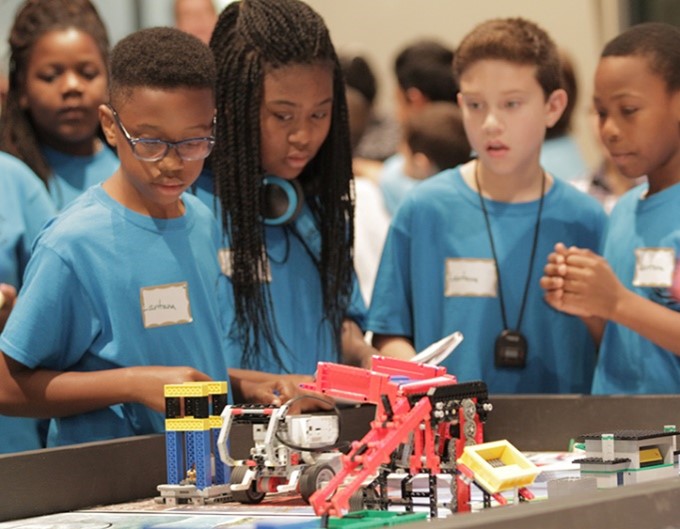
An Internet search for U.S. examples of how education is currently designed to support inventiveness reveals an interesting focus on robotics, even for younger students. The stories are inspiring. Kids can achieve great things, (Eg. a child inventing a robotic hand for an injured family member). These programs are designed to shape innovative mind sets. Typically, such education hands a really tough problem to students and asks them to come up with clever solutions. Education on the causes and consequences of climate change offers a rich base of such problems. It is ripe for challenging students and teachers to work on many creative solutions.
In their article for the Brooking Institution, analysts and education leaders Christina Kwauk and Rebecca Winthrop make the case for unleashing the creativity of teachers and students to address climate change. They start by looking at the global demand and then breaking it all the way down to the classroom and student level. For them, and for Cambridge University analyst, Viky Evans, in her article Why Education is Important in Tackling Climate Change, it is about catalyzing change and teaching the right skills, including innovation, for a changing world. The process for teaching inventiveness and innovation can begin in elementary school (see this ten tips article for example) and proceed through career and technical education at the secondary level and on into higher education. The idea of life-long learning, being coined as pre-K to gray, is gaining traction in the technology world because of its rapidly shifting nature.
Climate change is also making the economics of education more compelling. In addition to filling skills gaps, investors know that they can pour money into technology, including climate tech, but when their investments are backed by a creativity-prepared workforce, it is more lasting in its impact and the money is better spent. We will cover more on this education boost in future blogs.
It will be critical for the Congress to include funding for Department of Education primary and secondary education in the next update of the America COMPETES Act and to include climate-related training in the next update of the Carl Perkins Career and Technical Education Act. Other laws and agencies should also have a revised innovation emphasis.
Bottom line: solving the climate crisis will require new rules, new technologies, and, importantly, new ways of inventive thinking. The U.S. and other nations need to be investing in at-scale educational approaches that will more assertively help students to be innovative in rising to the challenge of global warming. Bill Gate’s call for a climate “miracle” will likely come, in large measure, from the creative, climate-educated minds of our youth. It is worth repeating that climate change is a multi-generational problem that demands a multi-generational response. In the process, we can make the U.S. more competitive in a fast-moving 21st Century economy.




 Climate Age
Leave a comment